Raw Stacks
- M81_275x180s.zip
- NGC6946_284x180s.zip
- NGC891_107x300s.zip
- NGC2403_107x180s.zip
- M101_Widefield_128x300s.zip
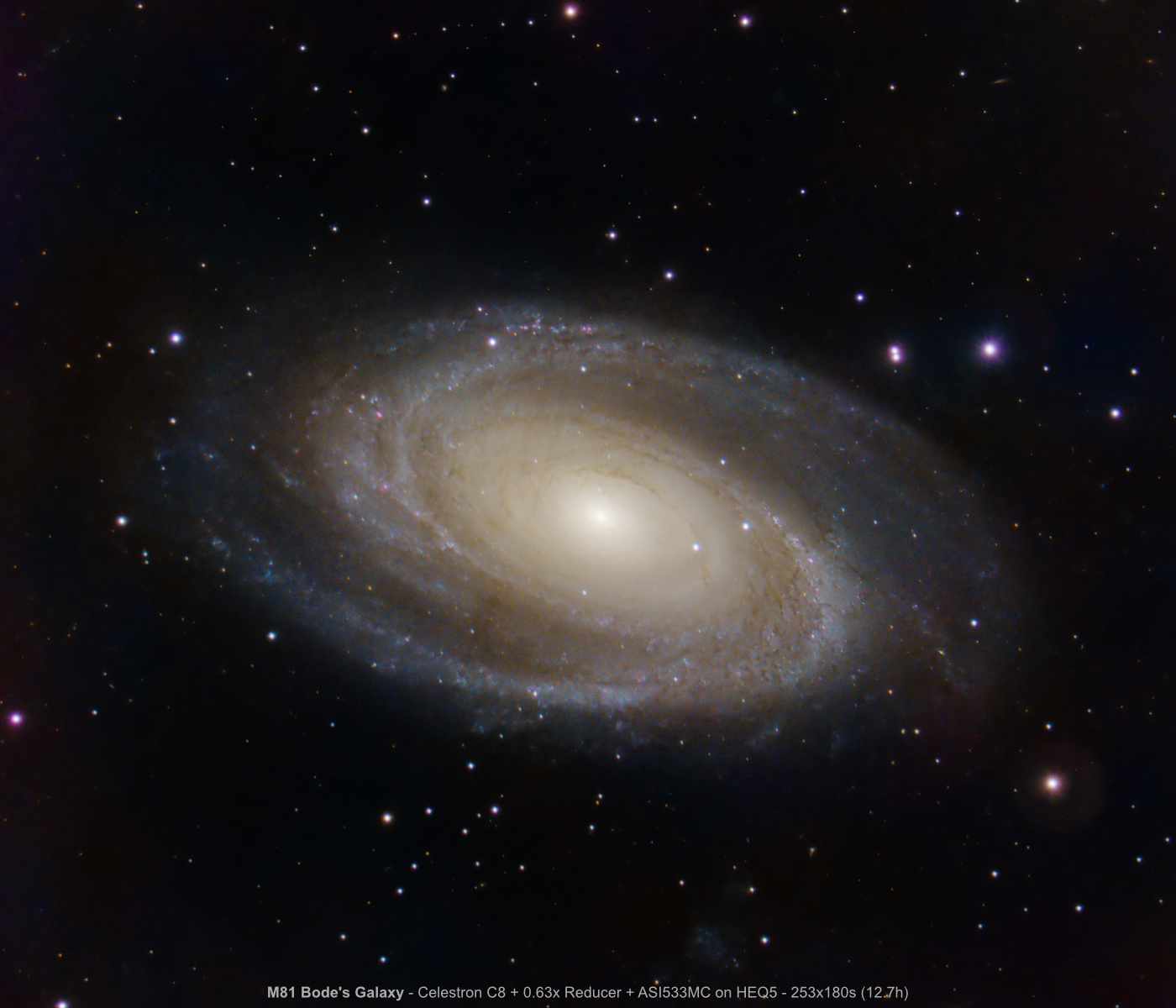
Bode’s Galaxy M 81
Bode’s Galaxy M81 is a great target for galaxy season in the northern hemisphere. It is high in the sky rather close to the NCP which makes tracking easy and keeps it visible for a long time during the night. It is one of the few objects where a lot of fine-structure can be seen inside the galaxy. The whole area has a lot of faint dust that my image below does not capture.
This image was done with a Celestron C8, the original 0.63x reducer/corrector and an ASI533MC (uncooled). Everything was mounted on a Skywatcher HEQ5 (with Rowan Belt Mod) together with 15 kg of counterweights on my backyard pier. Integration time is almost 14 hrs.
Raw stack from PixInsight can be downloaded here. It was calibrated with bias and flat frames. Standard settings from WBPP (2024) were used, incl. CFA drizzle at scale 1. It is slightly oversampled. This is 275x 180s at gain 101. Although I am generally not a fan of AI tools, I used BlurXTerminator for this image.
My processed imaged with details can be found on Astrobin. You can read about the this galaxy here on Wikipedia.
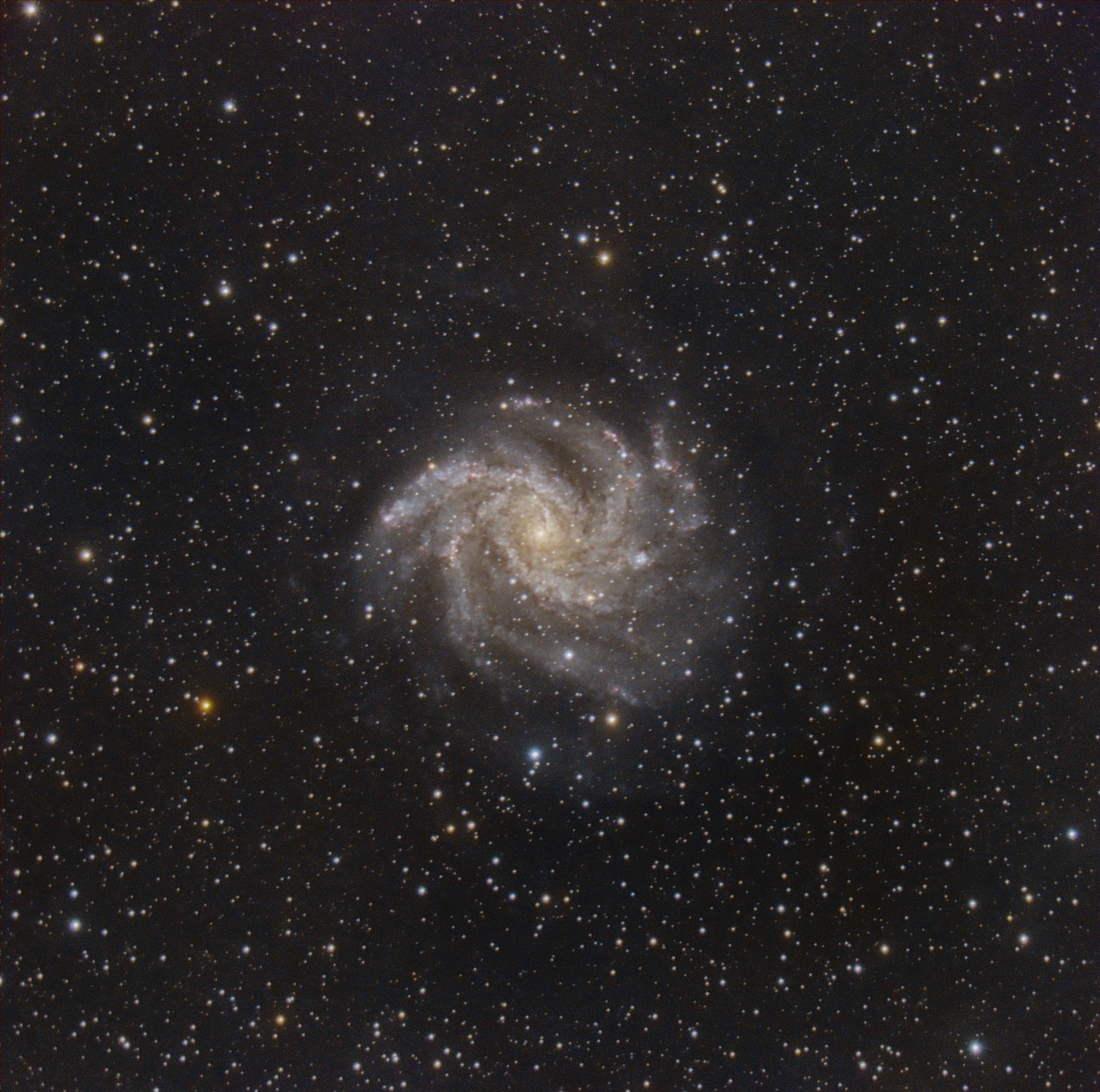
Fireworks Galaxy NGC 6946
The Fireworks Galaxy NGC 6946: This is the result from three nights. It’s amazing to see how fast you can swamp the readnoise with the ASI533MC. The sensitivity seems to be roughly 4x that of my old Nikon D3400. And this is with the uncooled model! Sadly, my seeing is mostly meh. It’s always 3“ at my place. Rarely it’s 2.5“ and similar rarely it’s 3.5“. Kind of boring.
This image was done with a Celestron C8, the original 0.63x reducer/corrector and an ASI533MC (uncooled). Everything was mounted on a Skywatcher HEQ5 (with Rowan Belt Mod) together with 15 kg of counterweights on my backyard pier. During processing I had to toss 40% of my frames from twining the nights due to wind and clouds. The HEQ5 is small for a C8 after all and it wasn’t the best weather. Integration time is a bit over 14 hrs from a three nights.
Raw stack from PixInsight can be downloaded here. It was calibrated with bias and flat frames. Standard settings from WBPP (2024) were used, incl. CFA drizzle at scale 1. It is slightly oversampled. This is 284x 180s at gain 101.
My processed imaged with details can be found on Astrobin. You can read about the this galaxy here on Wikipedia.
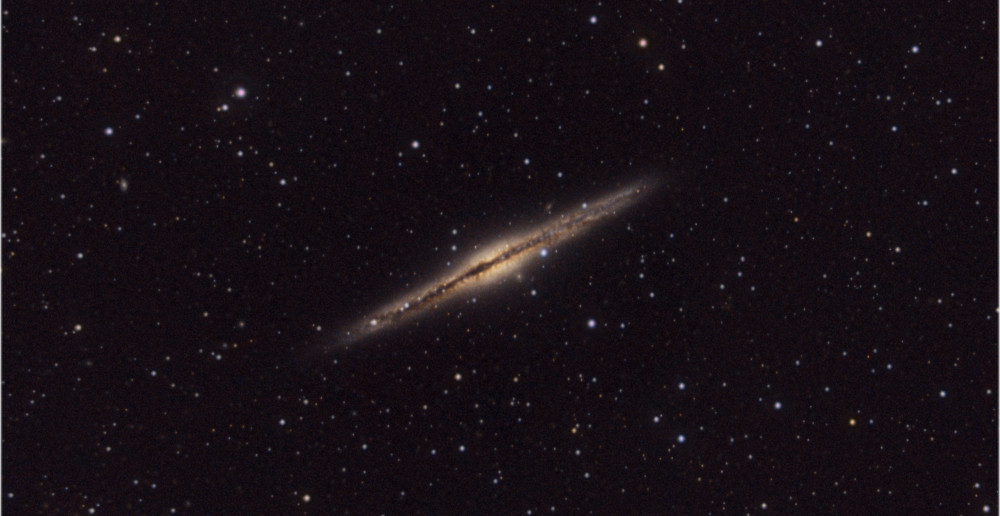
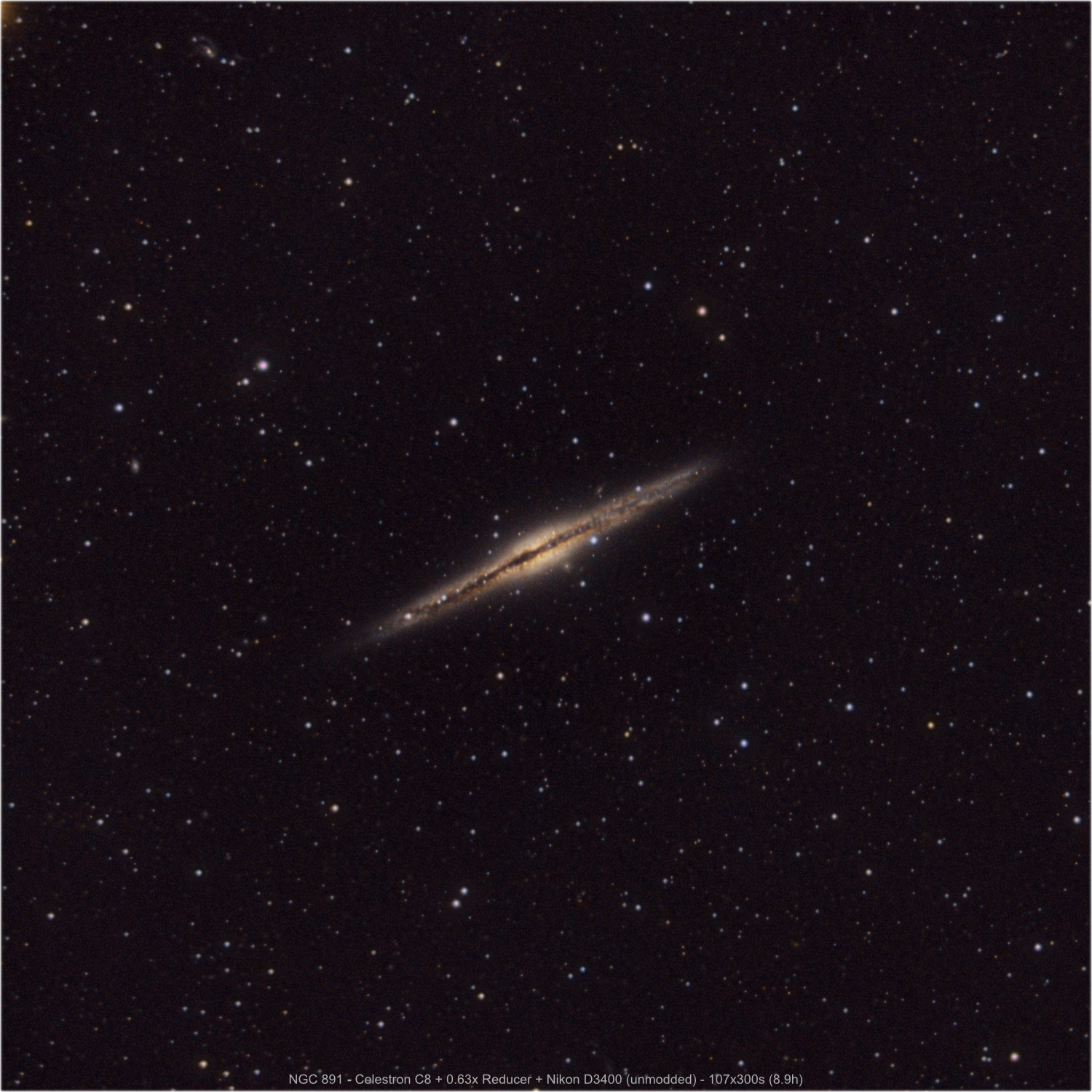
Spiral Galaxy NGC 891
The side-on-visible spiral galaxy NGC 891, also called the Outer Limits Galaxy. I consider it to be a very special object because it’s arguably one of my best images: I like the side-on view with lots of details in the galaxy and the nice colorful stars. This image was done with a Celestron C8, the original 0.63x reducer/corrector and a Nikon D3400 (unmodified). Everything was mounted on a Skywatcher HEQ5 (with Rowan Belt Mod) together with 15 kg of counterweights on my backyard pier. Integration time is a almost 9 hrs from three nights.
Raw stack from PixInsight can be downloaded here. It was calibrated with bias and flat frames. Standard settings from WBPP (2024) were used, incl. CFA drizzle at scale 1. It is slightly oversampled. This is 107x 300s at gain 101.
My processed imaged with details can be found on Astrobin. You can read about the this galaxy here on Wikipedia.
NGC 2403
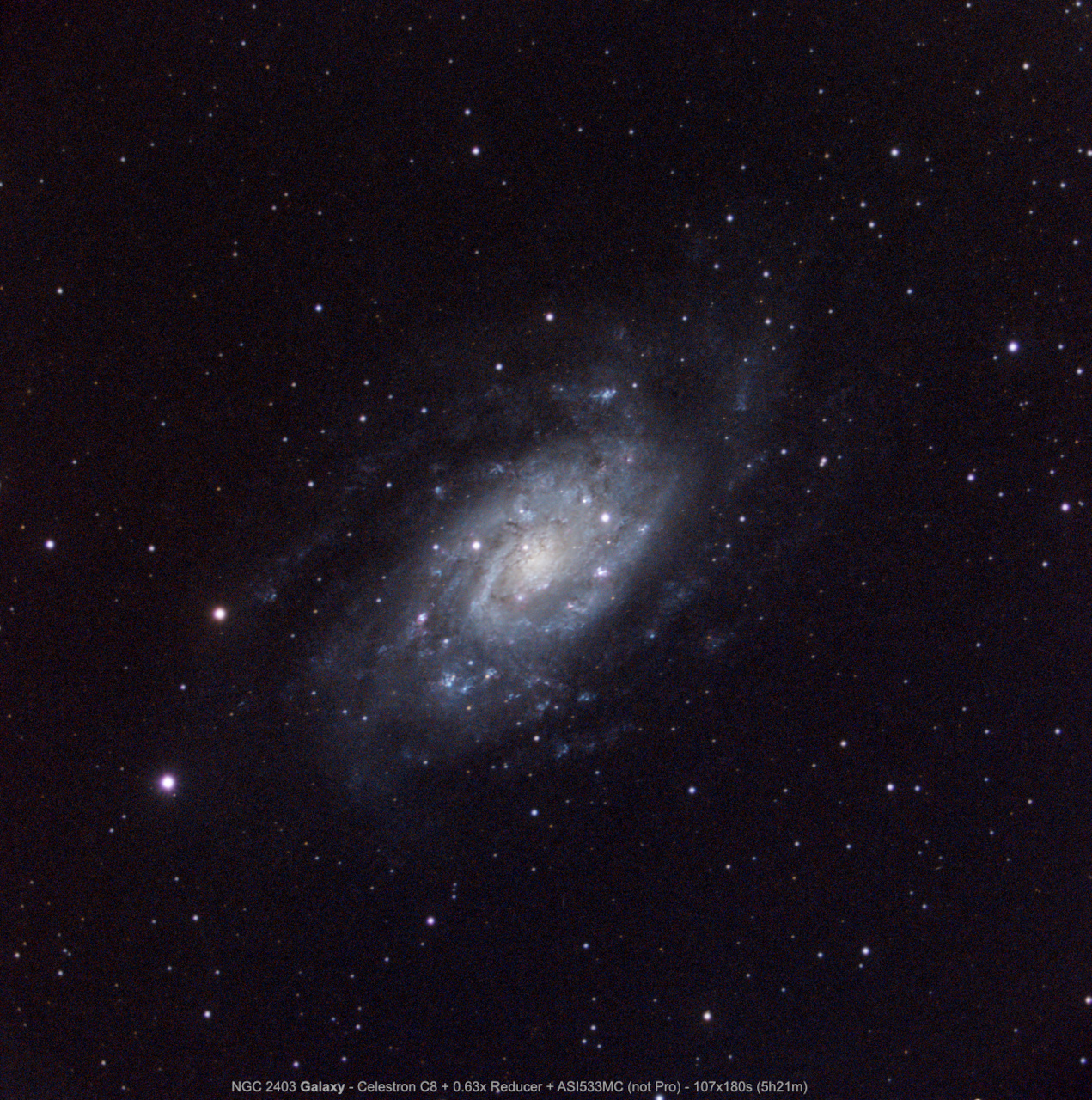
The galaxy NGC 2403 s a great target for galaxy season in the northern hemisphere. It is high in the sky rather close to the NCP which makes tracking easy and keeps it visible for a long time during the night. It is one of the less popular but very beautiful objects.
This image was done with a Celestron C8, the original 0.63x reducer/corrector and an ASI533MC (uncooled). Everything was mounted on a Skywatcher HEQ5 (with Rowan Belt Mod) together with 15 kg of counterweights on my backyard pier. Integration time is a bit over 5 hrs from a single night.
Raw stack from PixInsight can be downloaded here. It was calibrated with bias and flat frames. Standard settings from WBPP (2024) were used, incl. CFA drizzle at scale 1. It is slightly oversampled. This is 107x 180s at gain 101.
My processed imaged with details can be found on Astrobin. You can read about the this galaxy here on Wikipedia.
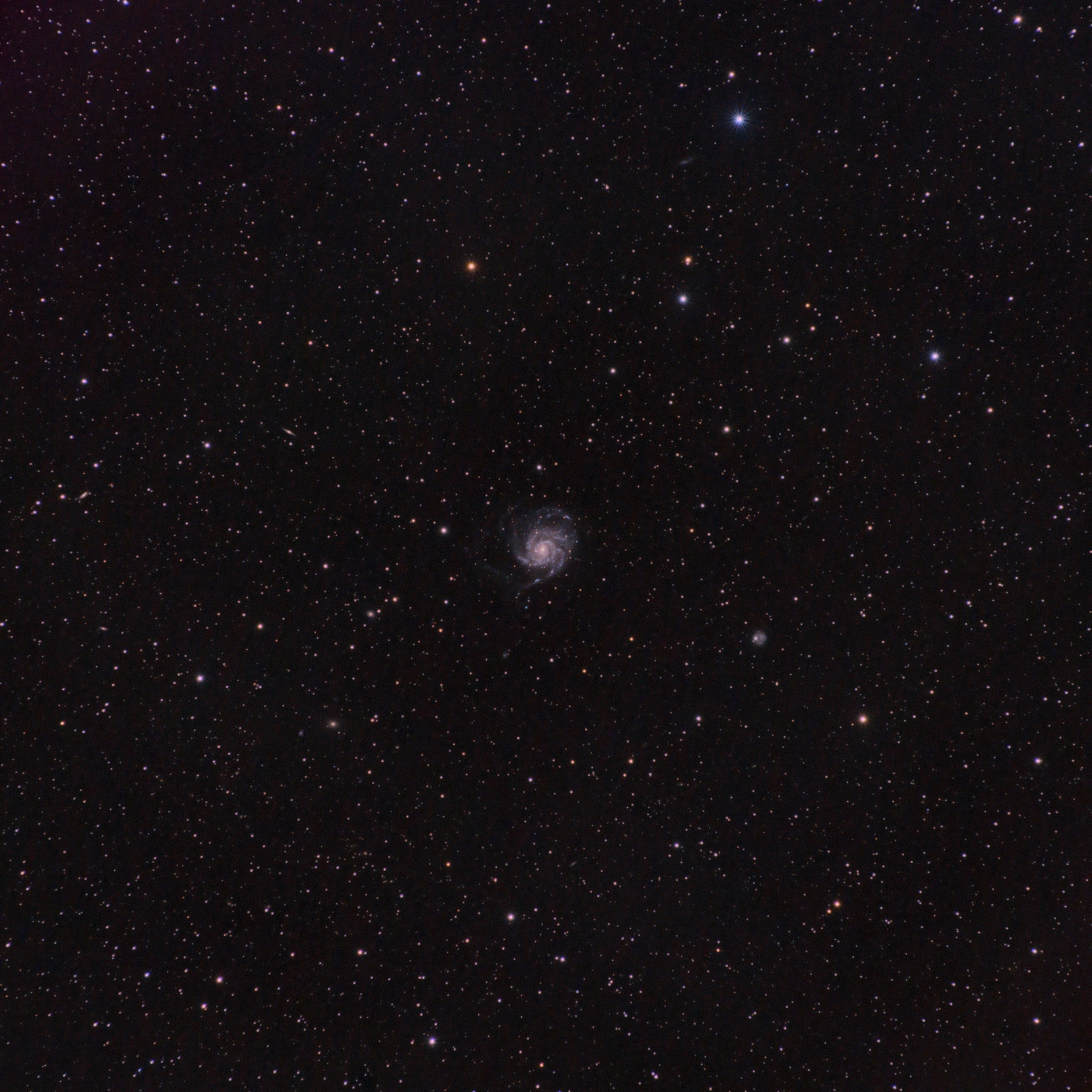
Pinwheel Galaxy M 101 (widefield)
Another object that is high in the sky in the northern hemisphere: the Pinwheel Galaxy M101.
This image shows a widefield view of the area. It was acquired with a 20 EUR Sigma zoom lens at 195mm focal length (stopped down to f/7 for better quality) and a unmodified Nikon D3400. Everything was mounted on a Skywatcher HEQ5 (with Rowan Belt Mod). I collected almost 11 hrs over five nights.
Raw stack from PixInsight can be downloaded here. It was calibrated with bias and flat frames. Standard settings from WBPP (2024) were used, incl. CFA drizzle at scale 1. This is 128x 300s subexposures.
My processed imaged with details can be found on Astrobin. You can read about the this galaxy here on Wikipedia.